Pages

Friday, November 20, 2009

Bicycle Project 2, day 4

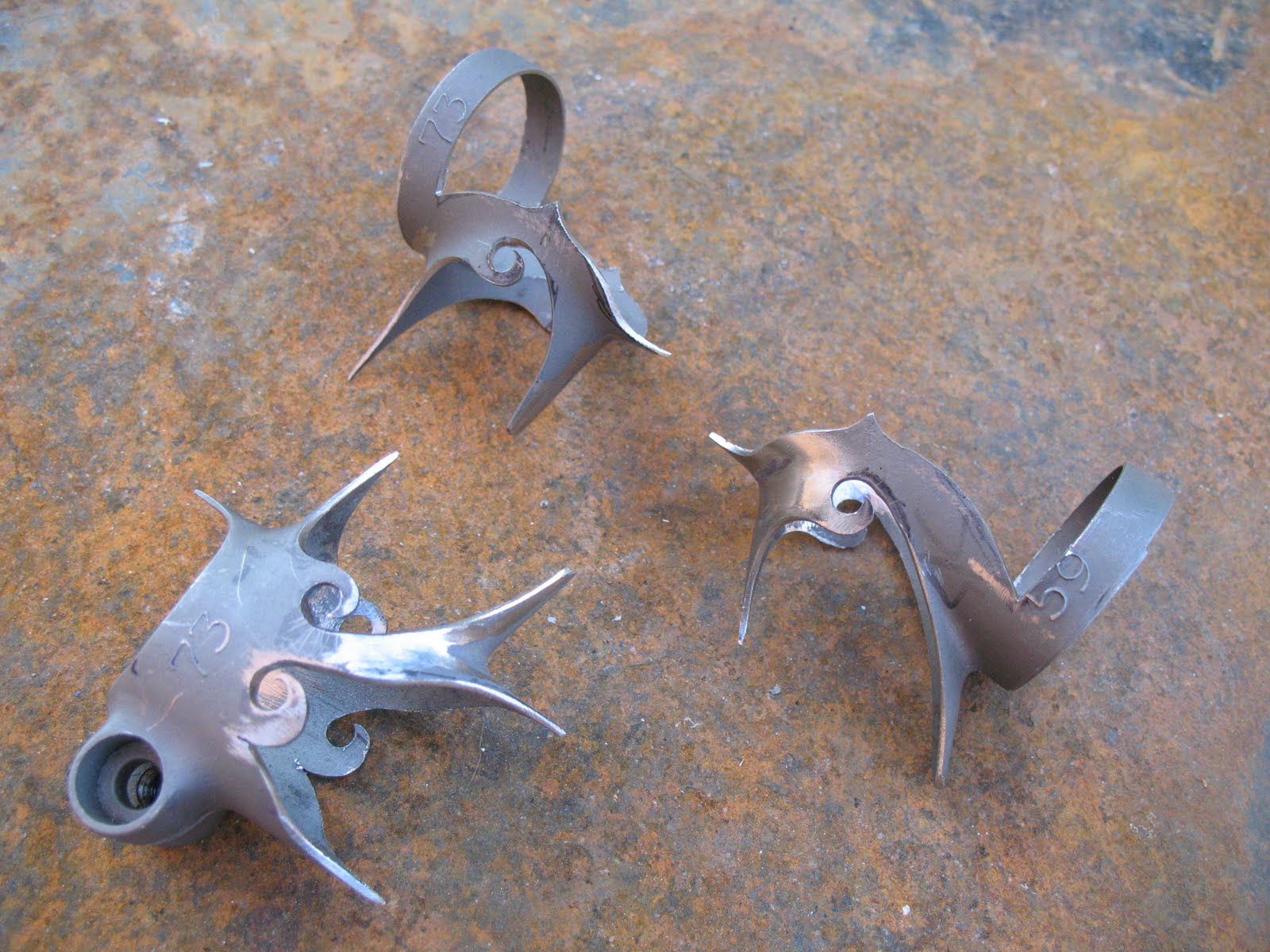
A brief hello then straight to the grindstone, literally. Back on to the sanding belts & buffer machine to grind out the imperfections on the bottom bracket. A few more corners here when compared to the dropouts gov'ner.


Probably a little too much time spent on the BB. The stainless lugs and the fork crown still need a lot of work.

Cutting out lugs takes time, patience, a good eye and a steady hand. That's why Dave doesn't usually offer this option in his frame-building class. But ask nicely and take the time to travel (17 hours) up from Australia and he's prepared to consider it.


Bottom bracket drilling to start some custom refinements.


I let Dave take care of some of the finer details.


Time out to have lunch and check out some old bicycle frames. A Glenn Erickson circa late 80's - early 90's and a Bianchi Competizione circa early 1960's. The Erickson is certainly a very well executed frame with clean shore lines, custom cutouts and nice even lug thinning. The Bianchi build is less refined with file marks evident and somewhat thick lugs but hey, it's a Bianchi with an integrated headset. That alone is style, history and cred and it's hard to see much further than that...

Dave scrutinizes the frames.


Then it's back to work with me supervising David Bohm on the more intricate seat lug work.

Dave under supervision.


Dave under close supervision.


The lug design is based on the Mercian Superlight. So to set things straight... an Australian travels to the United States to build a custom frame based on a mid-level British production bicycle. The world is clearly full of odd people...

Hey, the lugs are stainless and hand cut (unlike the Mercian)...

Thursday, November 19, 2009

Bicycle Project 2, day 3

Practice day and introduction to silver brazing. First there’s the prep work. Scrap tubing and practice lugs...


Mitering by hand

Not too bad


Yeah I'm pretty happy for a first-timer


Tube & lug surfaces prepared and fitted


Safety discussion then hello Mr Oxyacetylene Torch (um watch where you point that thing...)


After brazing


Flux removed


After sandblasting

Also prepared and polished the front and rear stainless dropouts but more on that later.


Wednesday, November 18, 2009

Bicycle Project 2, day 2

More theory! Some of the finer points of fillet brazing and lug brazing (bronze vs silver bearing alloys) and TIG welding. Even the mechanics behind Oxyacetylene torches, TIG (tungsten inert gas) and PAW (plasma arc welder). And a broad discussion of the various metal types and their properties. Thank goodness I have no plans for frame-building in the future as Dave would have gone into greater depth leaving me fatigued on the details.


Had lunch at an authentic Guatemalan restaurant (very tasty) and shot the breeze over differences between the United States and Australia. Even took a gander at Tucson Mountain National Park on the way back from dropping off a stainless steel plate for laser cutting the downtube name plate. (did you know that stainless steel needs a chromium content of 11% or more to provide an oxide coat that prevents rusting...)


Started work on the frame. Tubing is Kasai (formerly Ishiwata) standard diameter (1” or 25.4mm TT, 1 1/8” or 28.6mm DT) quad-butted 4130. Lugs are stainless Henry James with a standard HJ bottom bracket and Pacenti stainless twin-plate fork crown. Front and rear dropouts are custom made by Bohm from stainless steel plate.


head lugs have already been shaped by Bohemian Bicycles

Tuesday, November 17, 2009

Bicycle Project 2, day 1

I really enjoy bicycles. But 10 1/2 hours is a big day even when you are having fun.


Day one was mainly theory and the depth of immersion is up to your level of enquiry. Dave draws upon your knowledge and experience and takes it up as far as you care to go. Sure some of this are essential basics (say headset angle, rake and trail) but lead to areas so essential but much harder to describe in concrete terms (steering geometry and handling). Separating the hype (say the current trend of stiffness at any cost) from the important issues (handling for the riders weight and riding style, not to mention sizing & geometry) seems to be a big enchilada the independent frame builder. But they are preaching to the converted as we wouldn’t be there if we didn’t believe. Nonetheless, the more you learn the more you come realize how little you actually understood. All-in-all a very satisfying discussion that progressed throughout the day (even over lunch).


Obsolete lugged bicycles from the 1940’s to the 1990’s are an indulgence of mine. And Dave was happy to run this tangent with his own opinions and ideas. A frame builder with a couple of sets of Mario Confente lugs lying around is certainly worth listening to.


On a more practical level you draw up the frame using paper & pencil then Dave does the same thing using a computer program more accurately and infinitely faster (making you wonder why you did it on paper in the first place - ok it’s done so that you can understand the principles behind correct fit and geometry).


More tomorrow

Monday, November 16, 2009

George Carlin

Like many other bicycle enthusiasts out there bicycles form a small but significant part of my life. This cyclocentric blog allows me to vent in a socially acceptable way (ie in remote corner on the internet) so that I don’t bore or irritate the vast majority of people I have to interact with in the outside world.


I’ve just travelled for 17hrs from Australia to get to Tucson, Arizona to meet up with David Bohm of Bohemian Bicycles. Nice chap with a fairly relaxed manner from what I can tell so far. He brought brazed-on downtube lettering and the carved logos on the rear dropouts to the bicycle world. Yet people will say “you do that just like Sacha White*!” and he simply replies “Well yeah...”. Just quietly, I think Dave is pretty chuffed that I’m here (on the other hand, I’m surprised that not more people know about Bohemian Bicycles).


One Mexican dinner later and I’m laid up in my hotel room for most of the following day. So, I flick on the TV and discover George Carlin. A provocative comedian who provides insightful observations on the human condition, Mr Carlin won the Mark Twain prize for Humour in 2008. Check out George Carlin on YouTube.


This should be my only non-cycling post - but it does have a tenuous connection as I wouldn’t be in Tucson otherwise, eating authentic Mexican (and paying the price), then watching telly in the middle of the day...


Tomorrow I start building a bicycle with David Bohm.


* of Vanilla Bicycles (no doubt a master craftsman in his own right)

Friday, November 6, 2009

1940s Speedwell DeLuxe

There are some objects (from various areas of life) that seem to nurture a duty to preserve. The owner acts merely as a custodian so that future generations can recognize and hopefully enjoy the craft of an era now passed.


Most of the bicycle paraphernalia under my care are an indulgence without too much depth or meaning beyond the odd (in both sense of the word) bicycle enthusiast. This bike however might make the more general category of a historic object, bicycle or otherwise, worthy of preservation.


This is a unrestored Australian track bicycle made by Speedwell in the 1940’s. Speedwell, the Sydney competitor of the better known, Melbourne-based Malvern Star brand, is probably now remembered mainly as a mass producer of lower-end bicycles. However in the early days it did establish its reputation with some top-end frames.


This bicycle has a lovely patina that I find quite appealing


The lugs are somewhat unrefined when you compare them to the wonderfully intricate and feathered lugs that was starting to come out of Britain at the same time. However, down in colonial Australia the paint work was as coveted as the frame build - not to mention often equal in cost. And fancy pin-stripping was all the rage and somewhat peculiar to Australian bicycles of this era.


Nice painted headbadge


This is the only decal on the frame


Everything except the unglued, reused tubulars is original. From the flaky chromed steel spokes attaching the Airlight hubs to the Kundtz laminated wood rims, the weathered Mansfield Eclipse saddle, the custom-made steel track bars with cork inserts... And everything still turns & spins smoothly.


It takes a steady hand...


A quintessential Australian track bicycle from the 1940’s.


(last two pics courtesy of previous custodian)

Saturday, October 31, 2009

Campagnolo deltas on ebay

NOS Campagnolo delta brakes just sold today on ebay for USD $1,450.58. These are second generation versions with laser-etched logos on the face-plate that were apparently distributed to pro teams only. Apart from the etched Campagnolo winged wheel logo these are standard, but no doubt rare, 2nd generation delta brakes (the deltas sold to mere mortals had a screen-printed logo on the face-plate). Never seen them before and they would have been a nice addition to my collection but prices are clearly rallying (certainly beyond my reach) along with the world economy...

Broad face-plate, knurled cable adjusters, white-grey bellows, yellowing brake block adjusters - all standard 2nd generation stuff...

Mmmmm engraved faceplate hubba hubba...

Second generation internals

Second generation externals including tapered spacers to allow the caliper to clear the frame (first generation had symmetric spacers with inset for serrated washers on both sides), knurled cable adjusters (rather than the quick release) and clean transition from face-plate to caliper body on the undersurface (rather than a retaining clip for the face-plate).

Quick release on the brake lever (the first time Campagnolo did this and a function that is retained on current groupsets)

Some people incorrectly describe 1st generation deltas as "prototype" deltas thereby skipping a generation and calling these "first" generation deltas. The second generation delta brakes were the first of Campagnolo's delta configurations that worked without risk of catastrophic failure. For more detail see my first post in Aug 2008

BTW I should clarify that Campagnolo C record 1st generation components were never really "engraved" or "etched" in the sense that an cutting instrument was used to draw the logo into the surface of the metal. The winged wheel logos were stamped into the surface.

All pics taken from the ad by the Australian ebay seller

Saturday, October 24, 2009

Provenance and Nonsense

Nothing comforts like documentation.


But some things (including bicycles) tell their own story.


A cache name like Colnago carries a weight of respect and adulation with years of tradition, great riders and races won. The fact that some Colnago’s were dogs (true that most provide a wonderful ride even if build quality was lacking) are mere whispers in dark corners. The same applies to other marques that made plenty of production frames. The venerable Bianchi springs to mind.


Masi is another great marque although perhaps not as prominent today. Faliero Masi & Ernesto Colnago were near contemporaries with both learning their craft at Gloria then going their separate ways. Faliero went on to make a number of frames for Eddy Merckx (amongst other great cyclists) before going to Carlsbad, California in 1973. But I digress and there is a great wealth of reference material on the great frame maker known as “the Tailor”.


1974 Carlsbad Masi Gran Criterium with not-quite-period-correct-but-a-nice-match-anyway bars & saddle (repaint by Brian Baylis, put together by Harry S)


Nice lug detailing


Moving on. The Tre Volumetrica (3V) was arguably the tubing/ innovation that brought Alberto Masi out of the shadow of his renowned father. Oversized tubing with internal lugs brought a fresh approach to the standard fare of the lugged bicycle frame. Reflecting and probably propelling the modern trend of the stiff frame these bicycles were revered by racers and cycling aficionado’s. And boy were they expensive for a steel frame. But fashions change and the raised lip of the lug join now looks more akin to a plumbers handiwork than that of a master craftsman (despite the fact that it is harder to braze a frame with internal lugs). Then again, the lugged bicycle frame is kinda like plumbing...*


courtesy Chris 's Public Gallery on Picasa


courtesy Classic Rendezvous


So here’s a Masi track pursuit frame that I bought on ebay from a seller in the Ukraine. The paint and decals appear original and indicate a late 80’s to early 90’s American build.


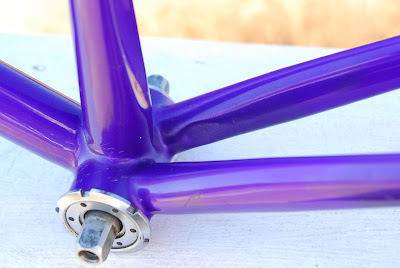
Pics courtesy of ebay seller. Level top tube with 26” front and 27” rear wheels


There are a number of interesting features with this frame. First, there is no serial number on the frame or fork, just a size indication (54.5) stamped into the bottom bracket. Second, there are True Temper decals on the frame and fork which are not seen on regular production 3Vs. Third, the lug lips have been filed away with the tubes merging smoothly into the lugs very much like some bilaminated frames (nice touch I might add). Fourth, the deeply grooved seat tube makes for a very tight rear triangle. Fifth, this frame has been used (and I mean really used...) although it still presents very nicely.


Fitted with Campagnolo steel track headset


So here’s my story (plausible but not necessarily true). This bike has been custom made for a track pursuit racer presumably in the USA. The build quality is impressive suggesting a rider of some standing. The bicycle has been raced then eventually sold or passed down when the original owner retired from the track or upgraded. Somewhere down the line it has been raced against a rider from Eastern Europe or from the former USSR and then passed on into the Eastern bloc. The now outdated frame has been touched up a number of times by its (relatively naive) new owner to regain some of its former glory. It then ended up in the possession of a collector/ ebay seller in the Ukraine. It now resides in Australia.


So there you go, a bicycle that wears it’s own provenance. No documentation. May be just nonsense.


But I’m comfortable with that.


Of course I could just ask Masi aficionado, Bob Hovey for his opinion...


*Saying that the lugged bicycle frame is mere plumbing is probably like saying that the Mona Lisa is mere oil paint on panel**

**Maybe the analogy is taken a little too far - a bicycle isn’t “true art” as true art deceives the viewer into thinking/ feeling that it is much more than the sum of its parts. A great bicycle simply shows off the sum of its parts. The ride adds the intangible emotion.

Saturday, October 17, 2009

San Rensho street bike

What’s with “coolness”? Or rather, what makes something “cool” as opposed to “uncool”. “Daggy” isn’t the opposite of “cool” as recent popular media has made being a “dag” or a “nerd” in some way “cool”.


Being cool seems to vary from place to place, changes over a period of time, and dependent on the prevailing culture. But there must be some defining features of the “cool”. Poise and confidence (or at least surety in oneself) is important. Someone or something with a special quality that others would like to emulate but different enough not to be one of the crowd. If too many follow then it becomes difficult to differentiate the cool innovator from the desperate wannabe.


I’m no social commentator nor a great observer of these things. But this is what I regard as my “coolest” bicycle (if there is such a thing). This is a 3Rensho with track geometry and provisions for caliper brakes. The standard track fork has a tight clearance requiring super-short reach calipers like the Diacompe BRS-200. But a period-correct, NOS Shimano 600 brakeset seemed to be more appropriate and sorta fits. In any case it’s a fixie so stop pedalling and the bike, um, sorta stops.

It's an original 1980’s fixed gear roadie with compromises that you can expect from modification of a track bike for road use*.


The standout feature is the crisp lug-work. Apparently brazed by Masahiko Makino under the watchful eye of Yoshi Konno when the latter was still building bikes under the 3Rensho name. The paint is original as is the surface rust. And therein lies the crux of this post. A wonderful frame, modified for a specific, and at the time slightly unusual purpose (fixed-gear road riding in the 80’s), that proudly bears the scars of service to its (original) owner. That to me is just plain "cool".


A WheatBix box wrapped around the spare tub adds an Australian touch to a quintessential Japanese bike. Velo carbon saddle, rusty 1970’s Simplex road skewers with a Surly chain-tug (requisite bottle opener included), and pedals from my old race bike finishes off the look.


Poise, class and confidence. Different enough to stand out on its own, yet within the realm of the common man. ‘Nuff said.


* 1. in addition, track forks don’t take braking loads very well - the round legs are not built to handle front-to-back loads and flex as the brakes are applied and 2. track geometry is kinda frisky on the road (at slower speeds)